Roots Analysis projected a $19.2 billion Conversational AI market in 2025, expanding to over $136 billion by 2035. Thus, context engineering can help enterprises to formalize this layer, bringing reliability, governance, and decision clarity to enterprise AI systems.
This blog breaks down what context engineering actually is, why it matters for production AI systems, where it shows up across enterprise applications, and what teams should do to implement it properly.
Table of Contents
- What is Context Engineering?
- Context Engineering vs Prompt Engineering vs RAG
- Why Context Engineering Matters for Enterprises?
- Where Context Engineering Shows Up in Enterprise AI Systems?
- Common Context Failures in Enterprise AI Systems
- What Enterprises Should Do Next?
- Conclusion
What is Context Engineering?
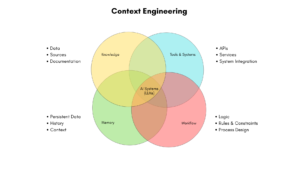
Context engineering is the discipline of designing what an AI system knows before it decides what to do. It includes building an effective workflow by providing relevant data and the right context to Large Language Models (LLMs), for better decisions and contextual outcomes.
The majority of enterprises mix up context engineering with conversational AI. It is often reduced to “prompts”, a chunk of text passed to a model. That’s prompt engineering. Context engineering has a broader objective. It’s not a conversational AI. It’s like architecting an entire AI environment with better context and reasoning.
This can range from task instructions and retrieved knowledge to user roles, user profiles, historical interactions, system rules, logic, business constraints, and memory. It also trains and gives AI the ability to use external tools and functions as needed.
Context Engineering vs Prompt Engineering vs RAG
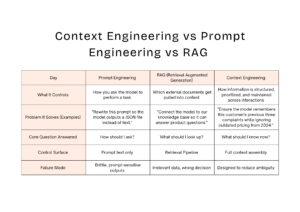
These three concepts often get mixed-up in enterprise AI discussions. They may appear similar, but at the core, they operate at different layers of the tech stack. It’s important to understand this distinction before we dive deep.
Why Context Engineering Matters for Enterprises?
Enterprise AI systems fail for a different reason than prototypes do.
In early experiments, AI systems operate in narrow, controlled scenarios. The inputs are predictable, the context is limited, and failures are easy to ignore. In production, those assumptions break down quickly. The system is exposed to changing data, multiple users, competing objectives, and real operational constraints.
These failures are difficult to detect, harder to debug, and expensive to correct after deployment. But context engineering addresses this by treating context as a governed system asset.
Think of it this way: a brilliant analyst given incomplete data will produce an incomplete analysis. The same applies to AI systems. Context engineering ensures your enterprise AI has access to relevant customer history, accurate product specifications, current policy documents, and appropriate business rules before generating a response or a decision.
Where Context Engineering Shows Up in Enterprise AI Systems?
It orchestrates how information flows in enterprise AI systems. The implementation looks different depending on the system, but the core discipline remains consistent. Some examples:
- In customer support automation, context engineering determines whether the bot sees the customer’s purchase history, open tickets, sentiment from previous interactions, and current account status before generating a response. Poor context design means treating a platinum customer like a first-time visitor.
- In document analysis workflows, it governs which sections of a 200-page contract get prioritized when answering specific questions.
- In code generation assistants, context engineering decides what gets loaded from the codebase, i.e., relevant API documentation, existing similar functions, deprecated patterns to avoid, and team-specific style guidelines.
- In data analytics copilots, it manages access to schema definitions, business logic rules, previous query patterns, and data quality flags.
Common Context Failures in Enterprise AI Systems
Most enterprise AI failures are subtle, intermittent, and easy to rationalize. Over time, however, they accumulate into systemic risk. Recognizing them early prevents expensive production incidents.
- Overloaded Context Windows: More context doesn’t mean better decisions. In practice, excessive context introduces noise, and important signals get buried among irrelevant details, and the system struggles to identify what actually matters.
- Correct Information, Wrong Application: Data updates, policies evolve, and user intent shifts. Context that is not refreshed or revalidated becomes a liability. A customer asks about return policies, but your system loads their entire browsing history and three unrelated FAQ documents. The actual return policy gets truncated or ignored entirely.
- Static Context in Dynamic Workflows: Another situation is AI systems reusing the same context across multiple steps or scenarios. As workflows branch and conditions change, static context causes systems to continue with outdated assumptions.
What Enterprises Should Do Next?
To start practicing context engineering, enterprises do not need to rebuild their AI systems to start practicing context engineering. What they need is a shift in how context is treated across design, development, and operations.
- Make Context Visible: In many systems, context is assembled implicitly through prompts, retrieval logic, and orchestration flows. Logging what context models are used along with their outputs and where it comes from creates the foundation for control and improvement
- Evaluate Context via Decisions, Not Data: When a system fails, trace backward, which documents were retrieved, how context windows were filled, and what information was truncated. It gives the visibility needed to diagnose and fix context failures systematically.
- Context Governance Policies: Instead of reacting to failures after deployment, embed policies, constraints, and role-based rules directly into the context design.
- Context-Aware Retrieval: Enterprises should factor in document freshness, source authority, user permissions, and task relevance. A document that’s semantically similar but outdated three years ago is worse than useless.
Conclusion
Enterprise AI systems are bottlenecked because of the informational architecture. As AI architectures become more autonomous and interconnected, the cost of unmanaged context increases. AI systems that cannot reason within the right constraints become harder to control, harder to trust, and harder to scale.
The models are capable. The infrastructure exists. What’s missing is disciplined thinking about how context flows through these systems.
Context Engineering brings that discipline to the environment. It structurally treats context as a designed, governed, and evolving system asset. It is the discipline that separates AI experiments from AI systems.