This is how cloud strategy is being treated as a company-wide declaration. The leadership team assesses various options, chooses a direction, and expects the rest of the organization to build toward it. While this reasoning works fine for brand identity, it often results in complications with cloud architecture.
The real issue isn’t which model is better to pick. It’s why enterprises still approach hybrid cloud vs. multi-cloud as a binary choice. And the decision doesn’t even belong at the strategy level at all. In this blog, we will talk about this binary dilemma and introduce the Workload-First Cloud Design – the principle that separates cloud environments that scale cleanly from those that quietly accumulate risk.
Table of Contents
- The Scenario: One Enterprise, Two Workloads, One Wrong Call
- What Each Model Actually Does (and Doesn’t Do)
- The Workload-First Cloud Design
- What Enterprises Should Do Next
- Conclusion
The Scenario: One Enterprise, Two Workloads, One Wrong Call
Imagine a SaaS logistics company comprising 300 employees, managing data shipments for enterprise clients across three regions. Their leadership decides to go fully multi-cloud. The reason? To avoid locking into one vendor, access the best services available, and keep the architecture flexible as they scale. Here’s what happened six months later:
- Outcome One: Customer data tied to the EU region ends up stored on a US-based public cloud server, and it is being processed outside the EU. It involves legal, IT, and client communications.
- Outcome Two: Data is moving between providers more than expected, resulting in the monthly cloud bill being higher than projected. The cost tracking isn’t centralized enough to catch it early.
- Outcome Three: A core part of the shipment tracking system starts returning inconsistent analytics. Enough to confuse the operations team and erode trust in the tool.
None of these happened because of the multi-cloud model choice. It happened because the same model was applied to every workload, regardless of what each one actually needed. The customer data needed a more controlled environment, and the data shipment needed consistency in tracking.
What Each Model Actually Does (and Doesn’t Do)
What Enterprises Think They’re Choosing
Hybrid Cloud is often seen as the safe bridge. You maintain essential systems in their current locations, expand into the cloud where it makes sense, and upgrade at your own pace. It offers a sense of control without sacrificing anything. It is chosen by enterprises when they have:
- Regulated or sensitive data
- Latency-sensitive workloads that need predictable performance
- Systems that need to integrate with legacy systems without a full migration
On the other hand, multi-cloud is about capability selection. Avoiding dependency on a single provider, distribute workloads, and use the best tool for each job. It gives numerous options to choose from. It is built for:
- High-availability requirements that demand geographic distribution
- Global-scale applications where a single provider’s regional outage would be catastrophic
What Actually Happens In Execution
In a hybrid configuration, the goal is to achieve smooth interaction between on-premises systems and cloud services. However, in reality, this interaction turns out to be one of the most challenging aspects to manage. Delays arise due to data synchronization. Network dependencies result in unforeseen bottlenecks.
In multi-cloud environments, the challenges shift. Every cloud service provider has its unique ecosystem, i.e., distinct tools, interfaces, and configurations. Teams often find themselves working across different stacks, frequently tackling similar challenges in varying ways. Over time, this results in fragmentation. Oversight across multiple environments decreases. Monitoring expenses becomes more complex.
The Workload-First Cloud Design
The cloud architecture decision isn’t made once at the strategy level. It’s made depending on the workload. And the enterprises that understand this stop treating hybrid and multi-cloud as competitors. This is what the Workload-First Cloud Design looks like in practice.
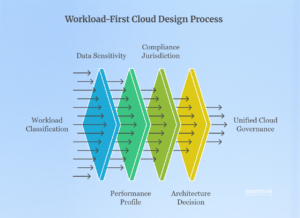
Before any infrastructure decision is made, workloads get classified across three dimensions: data sensitivity (regulated, operational, experimental), performance profile (latency-critical, batch, or real-time), and compliance jurisdiction (regional, cross-border, or internal only). The output of that classification directly informs the architecture.
- Regulated and latency-sensitive workloads route to hybrid-governed environments.
- Operational and experimental workloads, the ones that benefit most from best-of-breed services and elastic scale, go multi-cloud.
Note: A unified governance layer sits across both, ensuring consistent security policy, cost visibility, and observability regardless of where the workload lives.
Going back to the logistics company example: If their engineering team classified workloads first, the EU region data would have been placed in a hybrid-governed environment from day one. The real-time data movement and cost tracking would have run on a consistent, low-latency infrastructure. At the same time, the data shipment analytics would have remained in multi-cloud. Three different workload types, three different architecture decisions, all co-existing within one coherent cloud strategy.
What Enterprises Should Do Next
No restructuring or architecture build-up from scratch is required. The following three moves can give immediate clarity:
- Classify before you architect: Map your current workloads against data sensitivity and compliance requirements. Most enterprises find that around 20–30% of their workloads genuinely need hybrid governance; the rest are free to benefit from multi-cloud flexibility.
- Audit your current architecture against that classification: Where does the mismatch exist? Which workloads are currently sitting in the wrong environment, and what’s it costing you in compliance risk, FinOps waste, or operational fragility?
- Build a unified governance layer. Whether a workload lives in a private data center or across three public providers, the governance policy, security posture, cost visibility, and compliance controls should be consistent and centrally managed.
Conclusion
The logistics company in this scenario didn’t make a bad architectural decision. They made a premature one, before they understood the shape of what they were actually building. The core idea is that hybrid cloud and multi-cloud aren’t in competition. They solve different problems for different workloads, and the enterprises that get the most from both are the ones that stopped asking ‘which one?’ and started asking ‘which one, for what?’
That distinction is the difference between a cloud environment that scales cleanly and one that slowly accumulates the kind of complexity and technical debt nobody planned for.