In our previous blog, we talked about how context, memory, and iteration shape every vibe coding session. Context is what the AI knows when it starts. Memory is what carries forward with that context. Iteration is the repetitive cycle that acts like an engine. In this blog, we will dive deeper into how that engine actually runs: the feedback loop, what a productive vibe coding loop looks like from the inside, and how the loop keeps vibe coding productive.
Why Vibe Coding Sessions Feel Inconsistent
To understand this better, let’s imagine a scenario. Maya, a product manager at a SaaS company, needs a churn dashboard to understand which segments are leaving, at what rate, and over what time period. No developer is available, so she opens an AI coding tool and starts typing.
She’s not doing anything wrong by any standard definition. She’s describing what she wants, reviewing what appears, prompting again when something’s off. That’s the loop. The AI fixes the time range, but the churn pulls the metrics from a definition that nobody uses anymore. Maya corrects that, and the layout collapses again. Thirty minutes later, she has something that technically works but practically doesn’t. That’s the problem.
This is what a vibe coding session looks like when the fundamentals aren’t in place, and the fundamentals have nothing to do with the prompt.
Intent: The Starting Point Most People Skip
Maya’s first prompt was something close to “Build me a dashboard showing customer churn.” That’s a reasonable description, but it’s also almost entirely ambiguous. Churn over what period? Which segments? What’s the team’s agreed definition of churn — thirty days without activity, contract non-renewal, something else? The AI doesn’t know, so it makes assumptions. Reasonable ones, probably. But reasonable isn’t the same as right.
What does intent actually mean in a vibe coding session? The common answer to this question isn’t just describing what you want to build. It’s being specific enough that you’ve defined what correct looks like before the first output arrives. If Maya couldn’t answer “what does correct look like?” before her first prompt, the loop had no destination, as every output becomes a guess.
The fix is unglamorous: five minutes of clarity before the first prompt. What does success look like, specifically enough that you’d recognize it immediately? What would make this output wrong? What does the AI not know that you do? Those three questions don’t guarantee a perfect first output, but they give the loop somewhere to go.
Constraints: What Keeps the Loop From Spiraling
Since we established the intent before the prompt, we need to understand what the constraints are in a vibe coding session and why they matter more than the prompt.
Even with clearer intent, Maya’s session runs into problems. The AI pulls data from a legacy table that the engineering team deprecated six months ago. It uses a churn definition that the sales team invented, and nobody else agreed on. The layout ignores the internal tool Maya’s team works with every day.
Many may call this the same as memory. But it isn’t. And that’s the point. Constraints are everything the AI can’t infer from the prompt, i.e., the business rules, existing systems, and agreed definitions that only someone on the inside would know. Three types of constraints are worth defining before any session:
- Scope constraints: what the output should and shouldn’t include. Maya’s dashboard shows churn by segment, not by geography or plan tier, even though the AI might reasonably add both.
- Business constraints: the logic the organization has already agreed on. E.g., Which data source is authoritative? Which definition is current?
- Quality constraints: what “done” actually looks like. For Maya: matches the existing internal tool, fits the team’s design conventions, and loads in under three seconds.
The Feedback Loop: Productive vs. Doom Loop
There’s a version about what a feedback loop in vibe coding means, i.e., whether it’s a productive loop or a doom loop. The distinction matters because both feel like iteration. Both intend to solve the same problem, but with two completely different prompts. One expresses dissatisfaction; the other delivers a constraint.
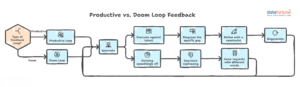
Maya’s turning point comes when she stops rephrasing and starts analyzing. Instead of typing “the layout is wrong, fix it,” she writes: “The sidebar should sit on the left, the chart should take up 60% of the main panel, and the filter dropdowns belong at the top, not inline with the data.”
The AI doesn’t need more tries. It needs more information. That’s the difference between a loop that converges on something good and one that runs indefinitely.
How All Three Work Together
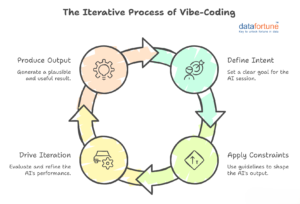
We can understand this as something like this: Intent gives the session a destination. Constraints are the road markings. The feedback loop is the drive.
- Remove the destination, and you’re circling — producing outputs that look plausible but don’t solve anything.
- Remove the road markings, and every iteration invents its own rules, which contradict each other.
- Without the drive, the discipline of evaluating, diagnosing, and refining rather than just re-prompting, you never arrive, regardless of how clear the destination is.
What changed in Maya’s session wasn’t the tool or the prompts. It was the structure she brought to the loop. By the end of her session — the version where she defined intent upfront, documented constraints before starting, and diagnosed gaps rather than rephrasing them — she has a working churn dashboard. Right data source, right definition, right layout. What began as thirty frustrating minutes became a focused hour with something real at the end.
What This Means in Practice
Before starting a vibe coding session, three questions are worth five minutes to get better results:
- What does a successful output look like, specifically enough that you’d recognize it immediately? That’s the intent.
- What does the AI not know that anyone inside your organization would? Those are your constraints.
- How will you evaluate each output before you respond to it? That’s what keeps the loop productive.
Vibe coding is fast by design. But the speed only compounds when the loop has somewhere to go. A doom loop is also fast; it just runs in the wrong direction.
At Datafortune, we help enterprises navigate the AI-assisted development landscape with clarity and confidence. Whether you’re evaluating AI coding tools, establishing review protocols, or scaling AI-assisted development across teams, our team will help you build a strategy that balances speed with security.
Let’s build your AI-assisted development strategy together. Schedule a consultation today!