Table of Contents
- Is Custom Application Development Worth The Investment?
- Custom Software vs. Off-The-Shelf Software
- How to Calculate Custom Software Application ROI?
- Short-Term ROI & Long-Term ROI: The Value Curve
- What Costs Should You Include?
- What Benefits Should You Measure?
- Conclusions
- FAQs
Is Custom Application Development Worth The Investment?
Or is that just what custom application development agencies say? Fair question, and the honest answer is: it depends on what you’re replacing. If your team is duct-taping five different tools together to run one workflow, or your off-the-shelf platform charges you per user for features you’ll never touch, custom application development stops being a luxury and starts being the cheaper option over a three-year horizon. But if your process is genuinely standard, like invoicing, basic CRM, and common HR functions, buying beats building almost every time.
The investment case for custom business applications gets stronger the more specific your workflow is. Generic software is built for the average customer. Your business isn’t average, and neither is the process that’s currently costing you time.
Custom Software vs. Off-The-Shelf Software
Off-the-shelf software wins on day one. It’s cheaper to start, faster to deploy, and someone else handles the updates. But day one isn’t where the real cost lives. Licensing fees compound every year, feature limitations force workarounds that eat staff hours, and the moment your workflow diverges even slightly from the vendor’s roadmap, you’re stuck waiting or paying for a custom module anyway.
Custom software development flips that curve. The upfront cost is higher, and the timeline is longer, but you’re not paying per seat forever, you’re not waiting on someone else’s release schedule, and the system is built around your process instead of the other way around. Neither option is universally right. The right question is which one stops costing you more the longer you use it.
How to Calculate Custom Software Application ROI?
The standard ROI formula, i.e., ROI = (Net Benefit − Total Cost) / Total Cost × 100, itself isn’t the hard part. What makes this genuinely difficult is that both numbers change depending on when you measure them.
For example, a custom application development project that looks like a loss in month three can look like one of the best decisions your company made by month eleven. Calculating ROI accurately means being honest about which costs are one-time versus recurring, and which benefits show up immediately versus after adoption catches up.
Short-Term ROI & Long-Term ROI: The Value Curve
Custom software application ROI doesn’t arrive as a single number on a single day. It moves through a curve, and every enterprise investment follows roughly the same shape.
The Value Curve describes the three stages every custom software application development investment moves through: the Investment Phase, where cost is fully realized but adoption is still low, and benefit is minimal; the Trough, the point right after launch where ROI looks worst on paper because the system is new, users are still learning it, and old processes haven’t fully been retired; and the Compounding Phase, where adoption stabilizes, workflows tighten, and the same system starts generating savings and revenue month over month without additional spend.
Most ROI conversations happen accidentally during the Trough, because that’s when leadership naturally checks in. That’s also precisely when the numbers look the most discouraging. Short-term ROI, measured in the first two or three months, will almost always undersell a custom software development project. Long-term ROI, measured at the 12- to 18-month mark, is where the real picture shows up.
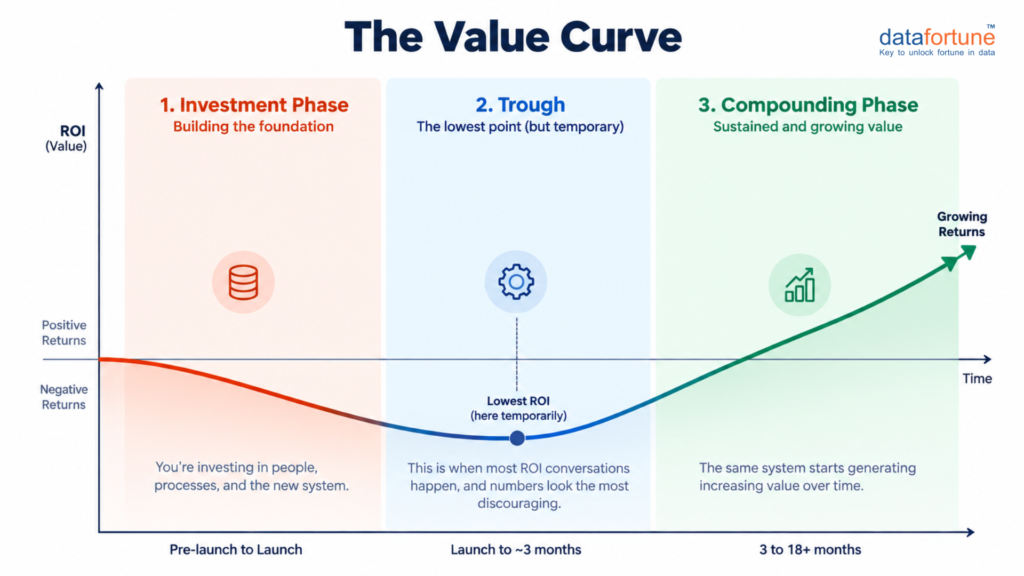
Knowing which stage you’re standing in before you draw a conclusion is, frankly, the single biggest factor in whether a company keeps investing in the right system or kills it too early.
What Costs Should You Include?
An accurate ROI calculation needs the full cost picture, not just the development invoice.
- Development cost: discovery, design, engineering, and QA, typically the largest line item.
- Implementation cost: data migration, integration with existing systems, and infrastructure setup.
- Training cost: the time it takes your team to actually adopt the new system, not just install it.
- Maintenance cost: bug fixes, updates, and hosting, usually 15–20% of the original build cost annually.
- Opportunity cost: what your team wasn’t doing while this project had their attention.
Skip any one of these, and your ROI number looks better than reality. That’s the fastest way to make a bad follow-up decision based on a good-looking first one.
What Benefits Should You Measure?
Benefits split into two categories, and both need a seat at the table.
- Productivity: hours saved per employee, per week, on tasks the software now automates or simplifies
- Operational efficiency: fewer manual handoffs, shorter process cycle times, lower error rates
- Revenue: new capability that opens a market, speeds up sales cycles, or reduces churn
- Customer experience: faster response times, fewer support tickets, higher satisfaction scores
- Reduced software and licensing costs: what you stop paying vendors for once the custom system replaces them
- Reduced technical debt; fewer workarounds, less shadow IT, a system your team can actually build on later
Some of these show up in week one. Most don’t show up until the Compounding Phase, which is exactly why measuring benefits too early tells you less about the software and more about how new it still is.
Conclusion
Measuring the ROI of custom software application development isn’t about finding the right formula. The formula’s the easy part. What actually determines whether you get an honest answer is timing, whether you’re judging the investment from the Trough or from the Compounding Phase, and whether you’ve accounted for the full cost and benefit picture instead of the parts that are easiest to measure early.
Frequently Asked Questions (FAQs)
Q1. How long does it take to see ROI from custom software development?
Most enterprise custom software reaches positive ROI between 12 and 18 months, though automation-heavy projects can break even faster, sometimes within six to twelve months.
Q2. Is custom software development more expensive than off-the-shelf software?
Upfront, usually yes. Over a three-year period, custom software often costs less once licensing fees, workarounds, and lost productivity from a poor fit are factored in.
Q3. What is the ROI of custom software development?
The ROI of custom software development averages well over 300% across three years for enterprise applications, according to Forrester research, with most organizations reaching payback within 12 to 18 months after launch. Automation-heavy projects can break even faster, sometimes within six to twelve months.
Q4. How do I calculate custom software ROI?
Custom software ROI is calculated using the formula (Net Benefit − Total Cost) / Total Cost × 100. Total cost should include development, implementation, training, and maintenance, while net benefit should capture productivity gains, operational efficiency, and revenue growth realized after user adoption stabilizes, not just in the first few months after launch.
Q5. How do I choose a custom software application development company?
The right custom software application development company should demonstrate relevant industry experience, transparent pricing and timelines, a clear post-launch support and maintenance plan, and case studies showing measurable ROI on comparable projects. It’s worth asking directly how they define and track ROI after delivery, since that answer usually reveals how the engagement will actually be run.
At Datafortune, we help enterprises plan custom software application development around realistic timelines, not just launch-day expectations, so the ROI conversation happens with the right numbers in front of it.
Let’s build a business case that holds up past month three. Schedule a consultation today.