This shift has boosted DevSecOps to evolve from reactive firefighting to proactive protection. In 2026, two DevSecOps practices: AIOps (one defined by intelligence and Zero Trust (one defined by verification) are changing the game. In this blog, we will explore how these together form an intelligent security framework.
Table of Contents
- AIOps: AI-Augmented Security For Your Security Team
- Zero Trust: Even “Inside The System” Doesn’t Mean Being Safe
- What This Means for Enterprises
- Conclusion
AI Ops: AI-Augmented Security For Your Security Team
Imagine James, a security analyst. Hundreds of security alerts scroll over his dashboard at 11 PM. The problem? Ninety-five percent are false alarms. But which five percent matter? By the time he finds the real threat, it’s already spreading.
AIOps changes this entirely. It learns what “normal” looks like for your systems. Instead of reacting to false positive alarms, systems begin identifying patterns, correlating signals, and predicting anomalies before they escalate.
Now the same scenario, AIOPs-enabled: An alert comes in at 7 PM. AI cross-references it against historical patterns, system behavior, and threat intelligence. It flags it as critical and routes it to James with context already attached. What used to take hours? Now 15 minutes. The threat never spreads. James leaves at a reasonable hour.
AppSec tools with AIOps-powered agents, like OpenAI’s Aardvark, act as a human security researcher who watches code repositories for unusual changes, monitors deployments for anomalies, and predicts vulnerabilities before exploitation.
Zero Trust: Even “Inside The System” Doesn’t Mean Being Safe
According to IBM, the estimated cost of cloud-native data breaches in 2026 is around $4.5 million. The reason? Traditional security models relied on perimeter defense. Once passed the perimeter, welcome to everything that’s inside the system.
Consider a scenario: David works from his favorite coffee shop. He connects to the corporate VPN, and suddenly he’s “inside” the network, databases, internal tools, customer records, everything. Convenient? Yes. But here’s the problem: anyone with his credentials gets the same access.
Zero Trust rethinks this. No automatic trust, even for insiders. Every access request gets verified: Who are you? What do you need? Why now? It doesn’t verify just once at login. It verifies constantly. Zero Trust also does behavioral analytics to detect unusual activity patterns.
Now, if David requests customer data for a quarterly report. The system checks: Is this really David? Does his role allow this? Is this normal behavior? Is he in an expected location? Access granted, but only to what he needs, only for as long as needed.
What This Means for Enterprises
Today, an enterprise gets hit from every aspect. Boards regularly ask for cyber exposure. Customers demand assured data protection. With AIOps and Zero Trust, DevSecOps evolves into a more security-focused practice for cloud-native developments.
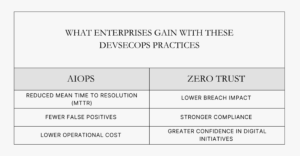
It doesn’t add complexity. It builds a security framework that protects invisibly and automatically.
Conclusion
AIOps and Zero Trust represent something bigger than two separate innovations. Together, they create a security framework that protects invisibly and automatically. It doesn’t add complexity. An autonomous DevSecOps is the future. For enterprises building a modern cloud-native ecosystem, this evolution is not optional. It is foundational.