According to Gartner, the acceptance of Decision Intelligence (DI) has risen steeply to 75% in the past couple of years. And the DI global market is projected to grow to over $47 billion by 2030. These numbers show the shift and what it actually means for the leaders making enterprise decisions.
Table of Contents
- What Business Intelligence Actually Does
- Where BI Stops
- Where Decision Intelligence Adds
- BI vs. DI: Side-by-Side Comparison
- What This Means for Enterprise Leaders
- Conclusion
What Business Intelligence Actually Does
BI is a well-built reporting machine. It aggregates data from across the organization, structures it into dashboards and reports, and gives teams a clear, consistent view of what has happened. For example, sales trends, operational throughput, quarterly performance, and release histories – BI handles all of this with precision and, over the years, increasing sophistication.
Consider a software engineering team preparing for a major product release. Their BI stack gives them stats: defect rates across the past deployment durations and support ticket volumes after previous releases. The data is accurate, well-organized, and genuinely useful for understanding the complete historical picture.
So if the data is all there, why do release decisions still feel uncertain?
Where BI Stops
The problem surfaces the moment the team has to make a call: ship on Friday, or delay?
The usual BI dashboards don’t answer that. They surface data points in isolation. For example, a spike in defect rates during Sprint 18 or a slower deployment last cycle. But they don’t weigh those signals against each other, and they don’t account for context that lives outside the data.
So someone has to synthesize it all manually. Layering in context from memory, Slack threads, and institutional knowledge – and make a judgment call under time pressure. That process is slow, inconsistent across different leaders, and almost impossible to audit.
The Knowing-Doing Gap exists because data alone doesn’t carry the analysis through to a decision.
Where Decision Intelligence Adds
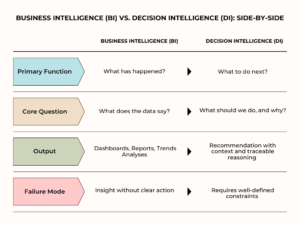
Instead of replacing BI, Decision Intelligence picks up exactly where BI stops. Where BI surfaces what happened, DI produces signals across sources, weights them against defined objectives and constraints, and gives a recommended course of action. All of this with the reasoning that is visible and traceable.
The same engineering team, with DI in place, gets a structured output: historical release patterns, deployment window constraints, and defined risk thresholds. The system recommends proceeding with the Friday release, with two flagged conditions that require sign-off before deployment goes live.
The team doesn’t have to reconstruct the reasoning themselves. The path from data to decision is built into the system. And because the logic is explicit, it can be challenged, refined, and improved over time.
How is Decision Intelligence different from Predictive Analytics?
The distinction is in the output. Predictive Analytics tells you what’s likely to happen. DI tells you what to do about it within the specific constraints. The output is the deliverable, not just the forecast.
Business Intelligence (BI) vs. Decision Intelligence (DI): Side-by-Side
What This Means for Enterprise Leaders
The ROI of Business Intelligence has always been contextual. It’s only as valuable as the decisions it informs. When those decisions are made inconsistently, slowly, or with gaps in reasoning, the value leaks regardless of how good the dashboards are. Decision Intelligence addresses that structurally.
- For CTOs: DI reduces the time that senior engineers spend reconstructing context before making deployment, architectural, or resourcing calls. That time compounds, and so does the cost when it’s consistently absorbed by your most expensive people.
- For Data Professionals: DI makes the logic behind decisions auditable. The contributing data, the applied weights, and the active constraints are all visible when a recommendation is generated. That matters for regulated environments, and for any organization trying to scale consistent decision-making across distributed teams.
- For Business Leaders: The competitive advantage of DI is speed without sacrificing quality of judgment. Organizations that can move from data to decision faster compress the time between identifying an opportunity and acting on it.
Conclusion
The engineering team that had a full dashboard and no clear answer now has a structured, reasoned recommendation. The data didn’t change. What changed is how it flows from observation to action.
The Knowing-Doing Gap closed because the system was designed to carry the analysis all the way through to a decision – with context, with reasoning, and with a traceable path back to the data that drove it.
For enterprises that have already invested heavily in BI infrastructure, Decision Intelligence isn’t a replacement. It’s where that investment finally pays off at the decision layer.
At Datafortune, we help enterprises design AI systems that support the decisions driving business outcomes. Whether you’re evaluating Decision Intelligence frameworks, building on existing BI infrastructure, or looking to close the gap between your analytics layer and your operational decisions, our team can help you get there with clarity.
Let’s build your decision intelligence strategy together. Schedule a consultation today!