Table of Contents
- What is AI Agent Memory?
- How does it work?
- Types of AI Agent Memory
- What is Retrieval in AI Agents?
- How is Retrieval different from RAG?
- What is Memory in Agentic AI?
- Retrieval vs Memory
- Why do AI Agents need both?
- Conclusion
- FAQs
What is AI Agent Memory?
AI agent memory is the system that gives ability to an agent to retain and recall information from previous interactions, tasks, and experiences. It gives an agent continuity, allowing it to use relevant information from the past when making decisions or taking action. Without it, an agent is stateless. Every prompt starts from zero, regardless of what was said or decided a moment ago. Memory is what turns a capable model into one that behaves as if it has actually been paying attention.
How does it work?
Every large language model runs on a fixed context window, whether short or long, i.e., the total space it can reason over in a single pass. Memory doesn’t live inside the model’s weights; it lives outside, in a store the agent writes to and reads from at the right moments. After an interaction, relevant details get extracted and saved. Before the next one, the agent queries that store and adds what’s relevant to the context window.
This is a deliberate design layer for every context window. But like a coin, this also has two sides. Short context windows don’t query the relevant information thoroughly enough, while bigger context windows delay the problem and add noise to the model.
Types of AI Agent Memory
AI agent memory splits along two lines: By Duration (how long information sticks around) and By Content (what kind of information it is).
By duration, there’s Short-term memory, also called working memory: the running state of the current session, gone once the session ends. Long-term memory persists across sessions, stored in a database, a vector index, or a graph, and it’s what lets an agent remember a user’s preferences months later.
By content, memory research points to three flavors, borrowed loosely from how psychologists describe human memory: semantic (facts and definitions), episodic (specific past events and their outcomes), and procedural (learned behaviors and rules, the how rather than the what). An enterprise agent rarely needs to dwell on which bucket it’s writing to. What matters more is understanding that all of this sits on one side of a larger split, separate from retrieval.
What Is Retrieval in AI Agents?
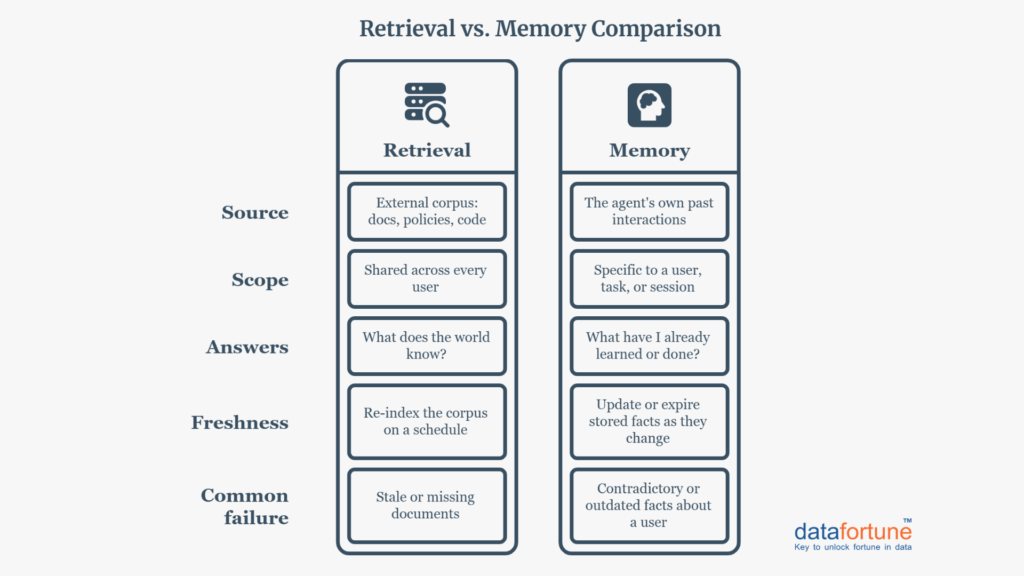
Retrieval answers a different kind of question: not “what have I learned” but “what does the world already know that I need right now.” It pulls from a corpus the agent didn’t generate and doesn’t own: product documentation, a codebase, policy files, case law, whatever the domain calls for.
How it works is fairly straightforward. Source material gets broken into chunks, each chunk becomes an embedding, and it lands in a vector index. When a query comes in, it gets embedded the same way, and the index returns the closest matches, inserted into the prompt. The corpus is shared. Every user asking about the same return policy hits the same index, refreshed on its own schedule, independent of any single conversation.
How Is Retrieval Different From RAG?
Though the two are used interchangeably often enough that the distinction is worth spelling out. Retrieval is the layer: the general capability of pulling external information into an agent’s context when it’s needed. Retrieval-Augmented Generation, or RAG, is one way to implement that layer, using embeddings and vector search. It’s the most common approach today, but not the only one; keyword search, structured queries, and hybrid methods count as retrieval too. Calling every retrieval system “RAG” is a bit like calling every car a sedan: maybe accurate often enough, but not precise.
What Is Memory in Agentic AI?
What retrieval reaches outward, memory reaches backward, into the agent’s own history. It answers a narrower question: what has this agent already learned, or what it needs to carry into the next interaction.
Memory splits along two lines: short-term memory and long-term memory. Short-term memory is cheap; it’s just session state. Long-term memory has to decide something retrieval never has to: what’s worth keeping in the first place. After every interaction, something has to extract the useful facts or decisions worth saving, then write them somewhere durable. At the start of the next session, the agent queries that store much like it would query a retrieval index, except the results are specific to that user, not shared across everyone using the system.
Retrieval vs Memory: Two Different Context Mechanisms in AI Systems
The cleanest way to keep retrieval and memory straight is to ask one question every time an agent needs information: did this come from outside the agent, or did the agent learn it itself? That’s the Origin Question, and it resolves most of the confusion enterprises run into when they design AI agent memory architecture.
Why Do AI Agents Need Both Retrieval and Memory?
- An agent with retrieval but no memory re-derives the same conclusions every session and can’t personalize a single interaction; that means it meets every user for the first time, forever.
- An agent with memory but no retrieval knows its own history in detail but has no way to ground itself in anything outside it. It can’t tell you about a policy that changed last week, because nothing brought that update in.
The enterprises getting this right treat retrieval and memory as complementary layers, then set clear rules for how the two combine: what gets priority when they overlap, how aggressively each gets pruned, and how much of either belongs in a given prompt. More retrieved documents or memory entries doesn’t automatically produce a better answer. Past a point, it just adds tokens the model has to weigh, and the signal gets buried in the noise.
Conclusion
The gap between an AI agent that feels genuinely useful rarely comes down to the model. It comes down to whether someone designed the memory architecture underneath it with intention, or bolted retrieval on and called it a day. The Origin Question won’t answer every architectural decision an enterprise AI team faces. But it answers the one that trips up the most teams early: whether the information an agent needs should be looked up, or remembered. Get that right, and the rest- what to store, how long to keep it, when to prune it- becomes a far more tractable problem.
Frequently Asked Questions (FAQs)
Q1. What is AI agent memory?
AI agent memory is the ability of an AI agent to retain and recall useful information from previous interactions, tasks, and experiences. It enables continuity across conversations and helps agents make decisions using relevant historical context.
Q2. What are the types of AI agent memory?
The commonly discussed types are short-term or working memory, episodic memory, semantic memory, and procedural memory. Each serves a different purpose, from maintaining current task context to retaining experiences, facts, and workflows.
Q3. What is the difference between retrieval and memory in AI agents?
Retrieval finds relevant information from an external source for the current task. Memory retains information from previous interactions or experiences so it can be recalled later. An effective agent can use both at the same time.
Q4. Is RAG the same as AI agent memory?
No. RAG is an architecture for retrieving external information and providing it to an LLM during generation. AI agent memory focuses on retaining information across interactions or tasks. RAG can support a memory system, but the two concepts serve different purposes.
Q5. Do AI agents need both retrieval and memory?
Many enterprise agents benefit from both. Retrieval helps them work with current, authoritative information, while memory gives them continuity and historical context. The right combination depends on the agent’s purpose, data requirements, and workflow.
At Datafortune, we help enterprises design AI agents built on the right memory architecture, from retrieval pipelines to long-term memory stores that actually hold up in production. Whether you’re scoping your first agent or fixing one that keeps forgetting what it should already know, we’ll help you get the foundation right.
Let’s design your AI agent’s memory architecture together. Schedule a consultation today.