Table of Contents
- Why RAG Needs More Than Retrieval?
- The Retrieval Relay: How Context Graph and RAG Interact
- Handoff One: Before Retrieval, the Graph Reads the Question
- Handoff Two: During Retrieval, RAG Finds, and the Graph Connects
- Handoff Three: After Retrieval, the Graph Attaches the Proof
- Comparison: Plain RAG vs. the Retrieval Relay
- Conclusion
- Frequently Asked Questions (FAQs)
Why RAG Needs More Than Retrieval?
Standard RAG behaves like a fast librarian. It converts your question into numbers, finds the passages whose numbers sit closest, and hands them to the language model. That works nicely for “what is our travel policy?” and badly for any question where the newest document wins. Why does RAG return outdated or conflicting answers? Version 2 and version 3 of the same policy look almost identical to a similarity search, and nothing in the index records that one replaced the other.
Two terms tend to get tangled here. GraphRAG is a technique that retrieves through the connections between things instead of similarity alone. A context graph is the layer of meaning those connections carry: when a rule took effect, what superseded it, who approved it, and why. A plain knowledge graph records what is generally true, whereas a context graph also records when, for whom, and on whose decision. We cover the full definition in What Is a Context Graph?; here, the focus is on how context graphs and RAG plug into each other.
The Retrieval Relay: How Context Graph and RAG Interact
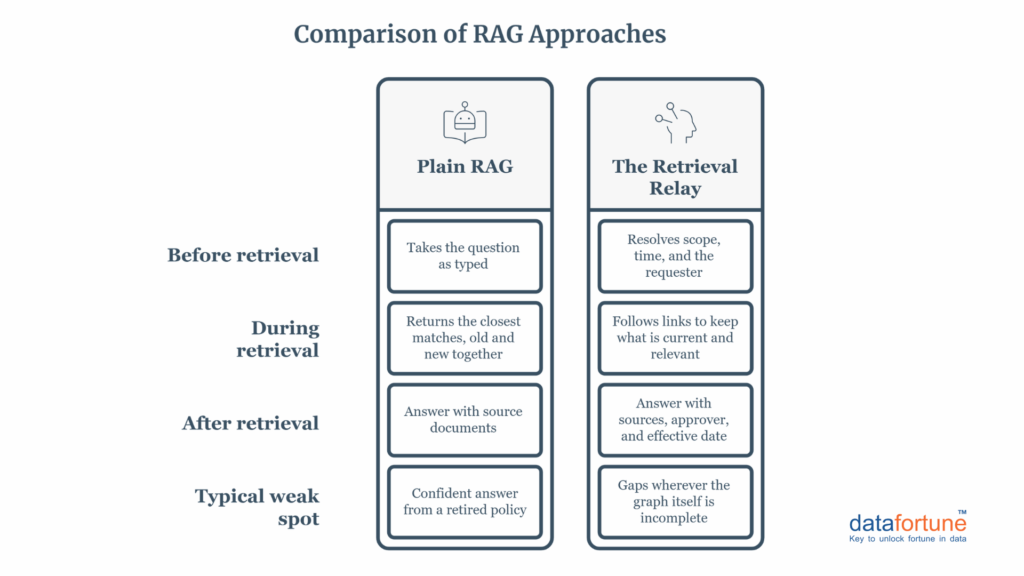
The Retrieval Relay is a method for combining RAG with a context graph in three handoffs. Before retrieval, the graph interprets the question. During retrieval, RAG finds candidates while the graph connects them and removes what is outdated. After retrieval, the graph supplies provenance, so every answer can be traced.
Picture a relay race where the baton is the user’s question. In The Retrieval Relay, the context graph and RAG pass it between them in three handoffs: before retrieval, during retrieval, and after it.
Meet Daniel, a data engineer in his second week at a financial services firm. He asks the company’s internal assistant which data retention policy applies to the EU customer export pipeline. A veteran colleague would answer instantly, but for a retrieval system, the question hides three separate problems.
Handoff One: Before Retrieval, the Graph Reads the Question
Most RAG systems take a question at face value, while a context graph gets the first look. How do context graphs improve RAG accuracy? They translate loose human wording into something the system can act on. “The EU customer export pipeline” resolves to a specific pipeline owned by a specific team, “applies” becomes “currently in force,” and Daniel’s role tells the system which policies he is cleared to see. This is context engineering in everyday form, and our guide to context engineering covers it in depth.
Handoff Two: During Retrieval, RAG Finds, and the Graph Connects
Now RAG pulls the candidate passages, and for Daniel it surfaces two documents that look like twins: version 2 and version 3 of the retention policy. Plain RAG usually stumbles here and serves both. What does the graph add that vector search cannot? It follows relationships. A “superseded by” link shows that version 2 retired in March, a “scoped to” link confirms version 3 covers EU pipelines, and a third link leads to a legal exception approved for a single export job. Hopping across documents like this is called multi-hop reasoning, the main reason GraphRAG draws so much attention. Our explainer on how a context graph works shows the nodes and edges behind it.
Handoff Three: After Retrieval, the Graph Attaches the Proof
Daniel’s assistant replies that exports must follow the retention period in version 3, and it names the approver and attaches the legal exception. How do you make a RAG answer traceable? By keeping the decision trace- the record of why a rule exists and who signed it off- next to the fact itself. For a CIO or compliance head, that trace marks the gap between an answer you can repeat to an auditor and one you simply hope is right. The steps for building it are in designing context graphs.
Comparison: Plain RAG vs. the Retrieval Relay
Conclusion
Return to Daniel one last time. His assistant has told him which policy governs, why it replaced the last one, and who approved the exception, and he never had to interrupt a senior colleague to learn any of it. That is what context graph RAG offers in practice: retrieval brings the candidates, the graph brings the judgment, and the answer arrives with its reasons attached. For an enterprise RAG pilot that stalled after the demo, this layer is often what earns people’s trust.
Frequently Asked Questions (FAQs)
Q1. Do context graphs and RAG compete, or work together?
They work together. RAG still finds the passages and the language model still writes the answer, while the context graph surrounds both, interpreting the question beforehand and sourcing the result afterward.
Q2. What is the difference between GraphRAG and a context graph?
GraphRAG is a retrieval technique that uses a graph to find connected information. A context graph adds the meaning, such as timing, ownership, and decisions, that makes those connections dependable.
Q3. Can a context graph reduce hallucinations in RAG systems?
It reduces one specific kind of error: answers built from outdated or mismatched sources. It cannot repair gaps in the underlying data.
Q4. When should an enterprise combine RAG with a context graph?
When correct answers depend on time, ownership, or precedent, as with policies, contracts, or data lineage. For simple lookups across a small document set, standard RAG is usually enough.
Q5. What data do you need before building one?
Start with metadata you likely already hold: owners, effective dates, version history, and approval records
At Datafortune, we help enterprises design and deploy AI systems built on well-structured context, from graph design to agentic AI implementation. Whether you are adding a graph layer to an existing RAG pipeline or starting fresh, we will help you build something that holds up beyond the demo.
Let’s design your retrieval layer together. Schedule a consultation today!