Table of Contents
- Why AI Risk Doesn’t Show Up on Day One
- A Quick Scenario: The Invoice That Almost Got Through
- The AI Risk Ledger: Four Entries, Never Closed
- Four-Stage Discipline For Enterprises and SMBs
- Conclusion
Why AI Risk Doesn’t Show Up on Day One
The majority of conversations about AI risk focus on the moment a system goes live: whether the model passed its tests, whether the launch review was thorough enough. That instinct comes from traditional software, where a defect either exists in the code or it doesn’t. AI systems behave differently. A model’s outputs shift as the data feeding it shifts, as usage grows past what it was originally tested on, and as the business context around it moves without anyone updating the system’s assumptions.
What makes AI risk difficult to catch? It rarely announces itself. It accumulates in small, individually forgivable increments: a slightly wider margin of error here, an edge case waved through there, until the gap between what the system was trusted to do and what it is actually doing has grown too wide to ignore quietly. This is the Exposure Curve, and it explains why so many AI incidents surface months after deployment, not during it.
A Quick Scenario: The Invoice That Almost Got Through
Imagine a mid-sized logistics company rolling out an AI tool to process vendor invoices automatically, matching line items against purchase orders and flagging mismatches for review. For the first two months, it worked well, and the finance team quietly treated it as an operational win. By month four, the tool had started flagging fewer mismatches.
Not because vendors had become more accurate, but because its tolerance for small discrepancies had widened as it kept processing invoices with minor formatting differences. Nobody had asked it to relax its standards; it had simply learned that pattern from what it kept seeing.
A $40,000 duplicate payment nearly cleared before a reviewer, working late on an unrelated audit, caught it manually. The tool hadn’t failed outright. It had drifted, unnoticed, exactly along the Exposure Curve.
The AI Risk Ledger: Four Entries, Never Closed
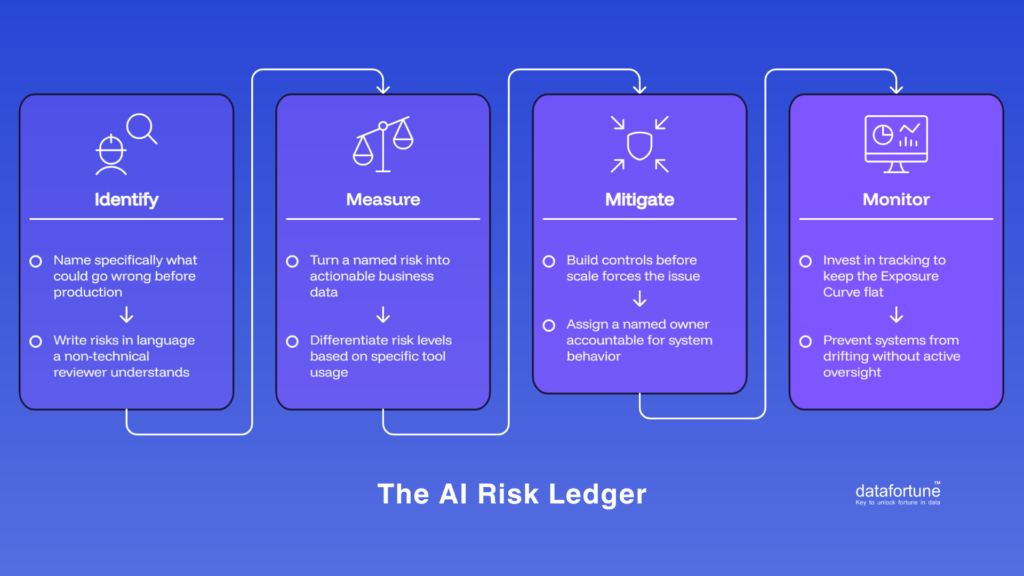
Managing AI risk effectively means treating it less like a one-time audit and more like an open ledger, one where every risk gets an entry, and that entry stays open until it has moved through four distinct states.
- Identify starts before a system reaches production. It means naming, specifically, what could go wrong: a model trained on historical data that no longer reflects the current customer base, a workflow where the AI decides without a human checkpoint, a dependency on a vendor whose data-handling practices are opaque. Teams with dedicated risk functions often skip the most useful part of this stage, writing the risk down in language a non-technical reviewer can understand, rather than logging it somewhere only engineering reads.
- Measure turns a named risk into something a business can act on. Rather than labeling a risk high, medium, or low, measuring means estimating what it would cost if it materialized, and how likely that is given current usage. A drifting invoice-matching tool and a customer-facing chatbot carry very different measured risk, even when both sit under the same “AI risk” line on a spreadsheet.
- Mitigate is where controls get built, before scale forces the issue, not after an incident does. That can mean a human-in-the-loop checkpoint for high-value decisions, a hard threshold the system cannot override, or simply a named owner accountable for the system’s behavior. Mitigation done well tends to be unremarkable by design, built so it doesn’t rely on someone remembering to check.
- Monitor is the stage most organizations underinvest in, and the one that determines whether the Exposure Curve stays flat or keeps climbing. Gartner projects that by 2028, more than half of enterprise cybersecurity incident response effort will be spent on incidents involving custom-built AI applications, a signal that the systems organizations trust the most are often the ones drifting the longest without anyone watching.
Four-Stage Discipline For Enterprises and SMBs
The instinct for many smaller teams is to assume this level of discipline belongs to companies with dedicated risk and compliance functions. The four stages themselves don’t change with headcount. A fifteen-person company running one AI tool for customer support still benefits from naming what could go wrong, estimating what it would cost, building one or two lightweight controls, and checking in on the system’s behavior monthly rather than never. What changes is who owns each stage. Whether the stage exists or not.
Does a small team really need all four stages? Usually, yes, just at a smaller scale. An enterprise might assign the Risk Ledger to a cross-functional committee reviewing dozens of systems quarterly. A smaller company might run the same four stages as a single recurring conversation between whoever owns the AI tool and whoever owns the budget it touches, revisited every time usage grows meaningfully.
Company size changes the resourcing behind the ledger. It doesn’t change what needs to be true for an AI system to stay trustworthy over time: someone has to keep the ledger, and someone has to keep looking at it
Conclusion
The invoice that nearly slipped through wasn’t caught by a smarter model. It was caught because someone, eventually, was looking. That’s the quiet argument at the center of AI risk management: the technology will keep improving, and the Exposure Curve will keep existing anyway, because risk in AI systems is a function of time and use, not just design. Keeping the Risk Ledger open and revisiting it as systems scale is what keeps that curve flat.
At Datafortune, we help enterprises and growing teams build AI systems and the risk discipline around them. Whether you’re standing up your first AI governance process or scaling one across dozens of systems, our team can help you build a framework that holds.
Let’s build your AI risk framework together. Schedule a consultation today.