Table of Contents
- What Antigravity Brings to the Table
- What Claude Code Brings to the Table
- Quick Comparison: Antigravity 2.0 vs Claude Code
- The Selection Framework: How to Choose
- Conclusion
What Antigravity Brings to the Table
What is Google Antigravity? Google answered this question for the first time when Google DeepMind launched it in November 2025. Recently, they released version 2.0 at Google I/O 2026. Initially, it was simply a VS Code fork, but the latest version has turned it into a five-surface agentic developer platform: a standalone desktop IDE, a terminal CLI, an SDK, a Managed Agents API, and an Enterprise Agent Platform.
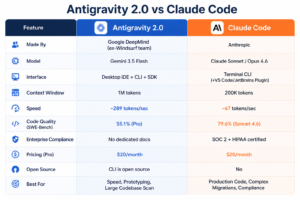
What makes Antigravity genuinely different is its architecture. Its defining advantage is parallelism. The Manager view acts as a control center, spawning and orchestrating multiple autonomous agents working in parallel across separate workspaces. For example, one writing backend logic, another handling API integration, and a third running tests. The underlying model, Gemini 3.5 Flash, processes roughly 289 tokens per second, nearly four times faster than Claude Code.
That said, the gaps are real and worth naming too. Compliance documentation is thin, there are no product-specific certifications, and enterprise pricing hasn’t been published. Since the platform is still stabilizing, none of these are permanent conditions, but for teams operating under governance constraints, they matter today.
What Claude Code Brings to the Table
Anthropic’s Claude Code does not try to replace your development environment. It drops into your terminal, reads your codebase, plans the work, and executes — showing you what it intends to change before it changes anything. Asking for approval before any significant action. It’s not a limitation of the tool; it’s the tool’s core argument about how much autonomy AI should have before a human reviews the decision.
What Claude Code trades in speed, it makes up for it in code quality and predictability. On SWE-Bench Verified — the benchmark that tests models against real GitHub issues from production codebases — Sonnet 4.6 scores 79.6% compared to Antigravity’s 55.1%.
Claude Code’s step-by-step approval model is a deliberate design choice, not a limitation. For regulated workloads, financial systems, and compliance-sensitive environments, having a human checkpoint before every significant change is the policy, not the bottleneck.
Quick Comparison: Antigravity 2.0 vs Claude Code
The Selection Framework: How to Choose
The decision gets easier when you stop asking which tool is better and start asking three more specific questions.
Q1. What kind of work is this tool handling?
Speed and parallelism matter most when the work is exploratory, such as prototypes, greenfield features, and rapid iteration cycles, where the blast radius of an error is low. Antigravity is built for exactly that context. But when the code is going into a billing system, a healthcare data pipeline, or a customer-facing service where an edge case in production costs real money, the calculus shifts. Claude Code’s approval model and production-code quality become the argument, not the constraint.
Q2. What does your team’s existing environment look like?
Antigravity is a full IDE replacement. Migrating to it means moving to a VS Code fork built on Open VSX, which doesn’t support extensions available only through Microsoft’s Marketplace. For teams standardized on specific plugins or running JetBrains environments, that’s a real adoption cost. Claude Code is built to live inside whatever environment your developers already use. Portability is less exciting than a new IDE, but it matters when you’re rolling something out across a team of 60 engineers.
Q3. What are your compliance and governance requirements?
For organizations in regulated industries, this question often resolves the decision before any pilot gets run. Either the compliance artifacts exist for procurement review, or they don’t. Claude Code has them. Antigravity doesn’t yet. For non-regulated environments, this matters less today, but it’s a gap worth monitoring as both tools continue to mature.
A practical way to start is to identify two task categories in your development lifecycle. One that prioritizes speed and iteration, and one that prioritizes reliability and auditability. Run each tool against the task category it’s better suited for. The results will tell you more than any benchmark comparison.
Conclusion
The choice between Antigravity 2.0 and Claude Code isn’t really a choice between good and better. It’s a choice between two tools that have made genuinely different bets about what enterprise development needs most right now. Antigravity bet on speed, orchestration, and a platform broad enough to cover the entire development surface. Claude Code bet on code quality, predictability, and a trust model that enterprise governance can actually rely on.
Both bets have merit. The teams that will get the most out of AI coding tools in 2026 are the ones that stopped treating it as a single pick and started building the judgment to match each tool to the work that actually suits it.
At Datafortune, we help enterprises evaluate and implement AI-assisted development tooling with the depth that production deployment requires, from tool selection frameworks to governance structures that actually hold. Let’s build your AI development strategy together. Schedule a consultation today.