What determines whether that loop produces something trustworthy or something that quietly falls apart is context, memory, and iteration working together. Strip any one of the three, and the loop still runs. It just runs toward the wrong outcome, sometimes without anyone noticing until the code is already in production.
Table of Contents
- Why Vibe Coding Sometimes Feels Magical (and Sometimes Terrible)
- Context: What the AI Knows When It Writes
- Memory: What Carries Forward (and What Gets Lost)
- Iteration: The Engine That Makes Vibe Coding Work
- How Context, Memory, and Iteration Work Together?
- What This Means for Enterprise Teams
- Conclusion
Why Vibe Coding Sometimes Feels Magical (and Sometimes Terrible)
Imagine two developers at the same company receive the same task, i.e., to build an internal dashboard. Nothing extraordinary. They both use the same AI coding tool. But before typing a single prompt, Engineer A spends ten minutes doing something. Engineer B opens the tool and starts immediately. Three days later, their outputs are unrecognizable from each other.
Engineer A’s dashboard integrates cleanly with the existing codebase, respects the team’s component library, and is nearly ready for internal review. Engineer B’s dashboard works technically, but it’s built on assumptions the team had already moved past. And by day three, the AI is contradicting decisions it made on day one.
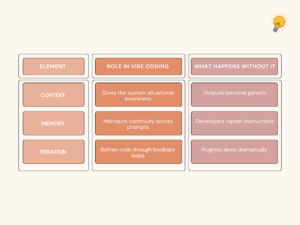
The difference? Neither talent nor the prompt. It was how deliberately each engineer managed three things: context, memory, and iteration.
Context: What the AI Knows When It Writes
Those eight minutes Engineer A spent before writing a single prompt? That was context design. Not a document dump. Not a wall of text pasted into a chat window. A curated starting picture: the existing tech stack, the component library the team actually uses, the API structure the dashboard needs to connect to, and a brief note on what the previous version got wrong.
In traditional development tools, context lives inside the developer’s head. Engineers understand the architecture and the dependencies that define a project. That’s exactly what Engineer B missed. The outcome Engineer B received was built for a project that didn’t exist. It had no relationship to the teams’ separate codebases or the product’s history.
This is the quiet failure mode of vibe coding at scale. Context is what bridges your intent and the AI’s output. Without it, even a well-written prompt is asking for the right thing in the wrong room.
Memory: What Carries Forward (and What Gets Lost)
AI systems often forget what has already happened. A developer may explain architectural decisions early in the session, only to find the AI-assistant ignoring those constraints a few prompts later. And it is one of the least visible risks in vibe coding. Memory in AI-assisted development can exist at several levels. And depending on what memory the AI-assistant is accessing, its decision-making drifts remarkably.
- Session Memory: The simplest form of memory, also known as conversational memory. The AI-assistant remembers earlier instructions, allowing the workflow to evolve through multiple prompts.
- Workspace Memory: When advanced AI systems extend their awareness to the entire repository. The assistant can identify where services live, which modules interact with each other, and how new features should integrate with the existing architecture.
- Behavioral Memory: The most powerful form of memory that captures developer preferences and learns patterns such as preferred networks, coding style, and architectural decisions.
Engineer A treated memory as a team responsibility, not as an AI feature. After each work session, key decisions were logged in a short, structured file: what was built, what was rejected, what constraints still applied. That file became the starting context for every subsequent session. The AI didn’t need to remember; it was reminded, precisely and consistently.
Iteration: The Engine That Makes Vibe Coding Work
If context provides awareness and memory preserves continuity, iteration provides progress. As we discussed earlier, vibe coding is not a one-stop process. It’s a rapid feedback loop. The iterative loop mirrors how experienced engineers already work: prototype, test, refine, and optimize.
But when something goes wrong in a vibe coding session, most people re-prompt. They rephrase the request, try a slightly different angle, and hope the next output is better. Just like what Engineer B did. That’s repetition. It’s not iteration.
When output missed the mark, Engineer A iterated. Real iteration closes the gap between what was generated and what was needed; not by repeating the request, but by diagnosing the gap and feeding the AI the precise context it lacked. It’s a discipline, not a workaround.
How Context, Memory, and Iteration Work Together?
Individually, each of these elements improves AI-assisted development. Together, they form the structural backbone of vibe coding. Think of them as three interconnected layers of the development workflow.
What This Means for Enterprise Teams
Firstly, context, memory, and iteration don’t make vibe coding work everywhere. They make it trustworthy within an honest scope. They amplify what’s already well-defined. They can’t substitute for the clarity that should exist before the first prompt is written.
Secondly, the two-engineer example used in this blog is a constrained illustration. Scale it to a team of twenty, or a hundred, and the gaps will multiply.
Lastly, knowing where vibe coding belongs in your development lifecycle is itself a strategic decision. For example, an internal analytics dashboard is a strong candidate: bounded scope, low blast radius if something breaks, clear success criteria. The same discipline applied to a billing engine or a healthcare data pipeline is a different conversation. The loop can still run, but the stakes of a missed constraint or a drifting memory are categorically higher.
The Code Confidence Spectrum, covered in detail in our Enterprise Guide to Vibe Coding, maps this clearly: from high-trust zones where AI-assisted development can move fast without heavy oversight, to non-negotiable zones where human expertise leads and AI assists.
Conclusion
The enterprises making vibe coding work at scale are treating these three elements as team-level infrastructure, not individual practice. Shared context files. Decision logs that feed back into sessions. Iteration protocols that are different from repetitions. That discipline is what separates vibe coding that accelerates from vibe coding that accumulates.
At Datafortune, we help enterprises navigate the AI-assisted development landscape with clarity and confidence. Whether you’re evaluating AI coding tools, establishing review protocols, or scaling AI-assisted development across teams, our team will help you build a strategy that balances speed with security.
Let’s build your AI-assisted development strategy together. Schedule a consultation today!