Table of Contents
- What is AI Security?
- AI Security vs AI Risk
- AI Risk Leads To AI Security
- Best AI Security Practices
- Conclusion
What is AI Security?
What is AI security, exactly? At its core, AI security is the practice of protecting AI systems, the models, the data feeding them, and the infrastructure running them, from threats that could compromise how they behave or what they expose. It sits at the intersection of two familiar disciplines, network security and endpoint security, except both now have to account for systems that learn, adapt, and sometimes act on their own. Put simply, security here asks two questions at once: is the network carrying AI traffic protected, and is every device running or calling a model protected too?
AI In Network Security
AI in network security handles traffic analysis, learning what normal data flow looks like across an enterprise so it can flag the moment something drifts from that baseline. It gives defenders visibility that static, rule-based tools never had. It strengthens intrusion detection, catching patterns a human analyst would likely miss buried in thousands of log entries. It powers firewall control, letting firewalls adjust their rules based on live behavior instead of a fixed list written months earlier. And it supports bandwidth protection, making sure a sudden spike in traffic, the kind that often signals an attack, gets contained before it can choke the network.
AI In Endpoint Security
AI in endpoint security shifts that same intelligence down to individual devices, laptops, servers, mobile phones, anything running or connecting to a model. It runs malware scanning that catches threats without a known signature, which matters because so many modern attacks are custom-built for a single target. It handles behavior monitoring, watching how a device or user typically acts so it can flag activity that quietly breaks pattern. It triggers automated isolation, cutting a compromised endpoint off from the rest of the network in seconds rather than hours. And it supports patch management, helping teams prioritize which vulnerabilities genuinely need attention first instead of patching everything at the same pace.
AI Security vs AI Risk
How is AI security different from AI risk? The two terms get used interchangeably, but they describe different things. AI security exists precisely because AI risk does. In simple words, one is exposure and the other is defense. Here’s a difference, side by side:
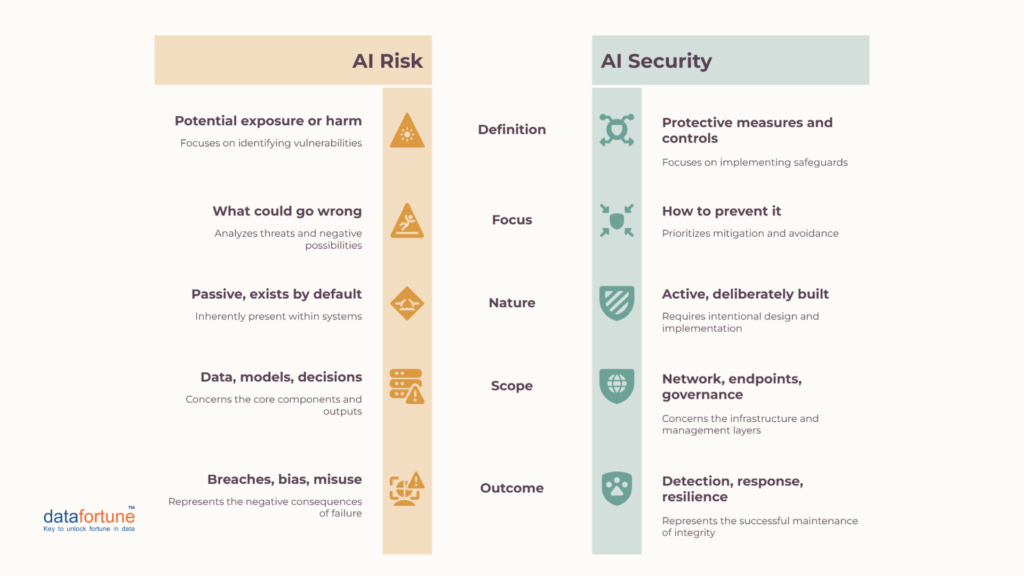
AI Risk Leads To AI Security
AI Security exists because specific, well-documented risks kept showing up in production, and someone had to answer for them. What are the biggest AI security risks going into 2026? Four keep resurfacing across enterprise deployments.
- Data breaches top the list. AI systems often sit closer to sensitive data than traditional software ever did, training on it, retrieving it, occasionally surfacing it in an output nobody intended.
- Adversarial attacks come next, where inputs are deliberately crafted to fool a model into misclassifying, leaking, or acting against its own guardrails.
- API vulnerabilities have grown just as fast; AI-linked API weaknesses jumped roughly 398 percent year over year recently, largely because APIs sit directly in the path between a model and everything it’s permitted to touch.
- Governance challenges round it out: opaque decision-making, unclear ownership, and access controls that were never designed with autonomous systems in mind.
Each of these risks demands a different kind of answer, and that’s exactly what the Risk-to-Response Model describes: AI security not as a layer bolted on afterward, but as the direct, mapped response to a specific category of AI risk. It treats every category of exposure- data, model, API, or governance- as the starting point for a corresponding, deliberately built defense.
Best AI Security Practices
What are the best AI security practices right now? The honest answer isn’t a single tool. It’s a handful of disciplined habits, stacked together and maintained consistently, the kind that separate a resilient enterprise AI security program from a reactive one.
Improving Data Privacy
Data privacy is where most AI security programs start, and for good reason: it’s where most AI risk concentrates. Differential privacy adds mathematical noise to datasets so individual records can’t be reverse-engineered from a model’s outputs, letting teams train on sensitive data without exposing the people behind it. Role-based access control narrows who can touch what, so a marketing analyst and a data scientist aren’t working with the same level of exposure to raw customer data. Data encryption protects information both at rest and in transit, turning a stolen dataset into something unreadable rather than a headline. And regular audits catch what the other three miss, quietly verifying that policies written months ago still match what’s actually happening in production today
Challenging Adversarial Attacks
Adversarial attacks tend to succeed when a model has never faced an attempt to fool it before. The fix is uncomfortable but straightforward: test it yourself, first. Enterprises that run structured adversarial testing, feeding a model deliberately crafted inputs to see where it breaks, catch weaknesses long before a real attacker does. This isn’t a one-time exercise either. Models change, retrain, and get fine-tuned, and each version deserves its own round of stress-testing rather than inheriting a pass from an earlier one.
Securing APIs and Endpoints
APIs are how most AI systems talk to the rest of the enterprise, which makes them one of the more exploitable surfaces in a modern AI stack. Strong authentication, rate limiting, and continuous monitoring for unusual query patterns close most of the obvious gaps. Endpoints deserve the same discipline: every device that can call or run a model should be treated as a potential entry point, not an afterthought bolted on once the model itself is secured.
Establishing AI Security Governance
None of the practices above hold up without governance behind them. Establishing AI security governance means defining who owns AI risk decisions, documenting how models get approved before deployment, and building in enough transparency that a team can explain why a model did what it did. Frameworks like the NIST AI Risk Management Framework give enterprises a starting structure, but the real work is cultural: treating governance as an ongoing responsibility, not a one-time compliance checkbox.
Conclusion
AI security in 2026 isn’t a separate initiative bolted onto an AI strategy. It’s the discipline that makes the strategy survivable. Every risk this blog covered- data exposure, adversarial manipulation, API weaknesses, governance gaps- has a direct, mappable response. Enterprises that treat it this way, as a response system rather than a scattered checklist, spend less time firefighting and more time building AI their teams and customers can actually trust.
Frequently Asked Questions (FAQs)
- What is AI security?
AI security is the practice of protecting AI models, applications, data, APIs, and connected infrastructure from unauthorized access, attacks, misuse, and data exposure. It also includes using AI to strengthen cybersecurity through threat detection, behavioral analysis, anomaly detection, and automated response.
- Why is AI security important for enterprises?
AI security is important because enterprise AI systems increasingly connect to sensitive data, business applications, APIs, and automated workflows. Strong security controls help organizations protect that information, limit unauthorized actions, detect threats, and scale AI adoption without introducing unnecessary security and compliance risks.
- What are the biggest AI security risks in 2026?
The biggest AI security risks include data exposure, prompt injection, adversarial attacks, API vulnerabilities, data and model poisoning, excessive AI agency, and governance gaps. The risk increases when AI systems can access sensitive enterprise data or take actions through connected applications and tools.
- How can enterprises secure AI systems?
Enterprises can secure AI systems by applying role-based access controls, encrypting sensitive data, limiting AI permissions, securing APIs, testing for adversarial attacks, validating inputs and outputs, monitoring AI behavior, and establishing clear AI security governance. High-impact AI actions should also include appropriate human oversight.
- What is the difference between AI security and AI risk?
AI security focuses on protecting AI systems, data, models, applications, and infrastructure from cybersecurity threats. AI risk is broader and covers potential security, privacy, operational, compliance, and business consequences associated with developing and using AI.